I copied a shapefile path into a chat box and asked Claude to build a map. A few seconds later, QGIS opened a new project, loaded a Seattle bus network, zoomed to the extent, and reported the feature count back to me. I never touched the QGIS interface. That is what AI in QGIS looks […]

AI for GIS: 5 Prompts That Replace Hours of Work
I lost most of an afternoon once to a column of addresses that would not standardize. Some had “ST” where I wanted “Street,” some wanted “Saint,” and a few coordinates were cut off at the wrong digit. I wrote a regex from scratch, then rewrote it twice. The work was tedious, the kind that drains […]
Airflow + AI + Iceberg V3: The New Stack for Scalable Geospatial Data
TOP OF THE STACK Recently I have talked about Airflow, and I have talked about Agentic AI, but not the two together. Well with the release of the Airflow AI SDK from Astronomer you can now do both, together. Check out this video from The Data Guy (aka George Yates) about this functionality. Take a look and let me know […]
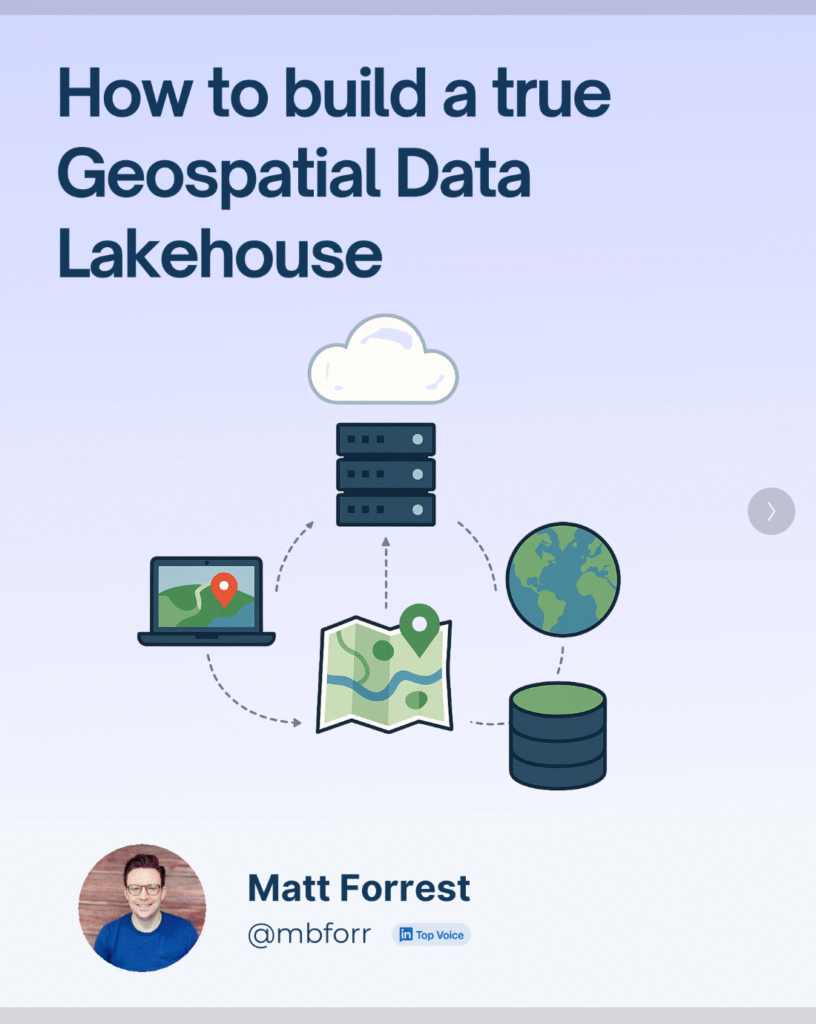
How to Build a Cloud-Native Spatial Data Lakehouse
Most spatial workflows today are still running on a foundation of folders, flat files, and fragile scripts. You’ve probably worked with shapefiles stored in six different places, Python notebooks that quietly break when a column changes, and a dozen versions of the same dataset ending in _final_v2_edit.shp. I’ve been there. But spatial data has changed. […]
How Cloud Storage Powers Cloud-Native Geospatial, AI, and Analytics
Look we can throw around a lot of terms about cloud-native and how geospatial is moving to the cloud, but none of this happens if it isn’t for cloud storage. Yes, this post is going to talk about storage. It’s one of the fundamentally more vanilla topics when discussion the cloud. When you boil it […]