
Imposter Syndrome in GIS: Why You Feel It (and How to Move Through It)
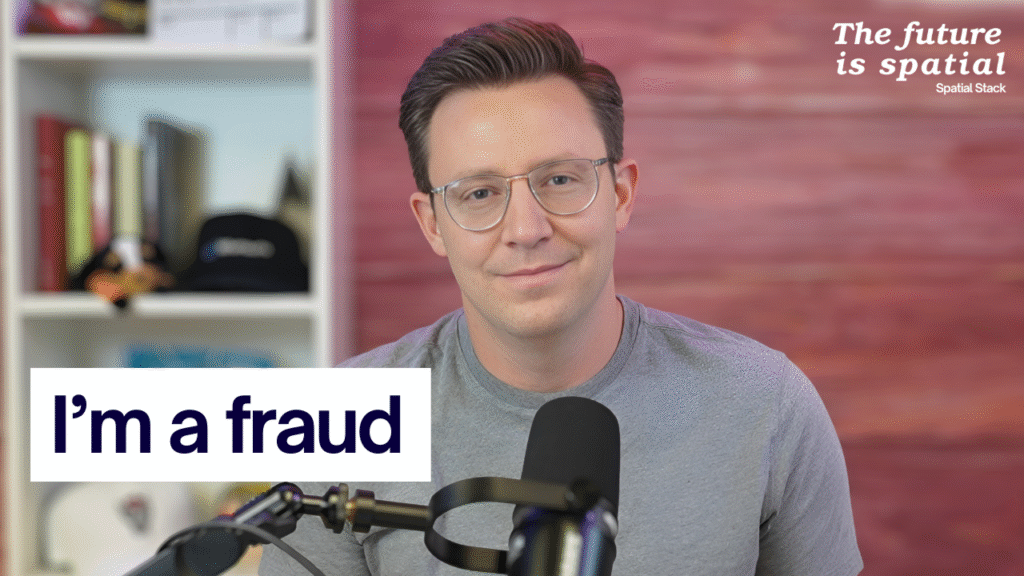
This wasn’t an episode I originally planned to record. But the more I saw conversations around imposter syndrome in GIS, the more I realized it needed to be said out loud.
Because nearly everyone in this field — from students to senior data engineers — has felt that voice in the back of their mind whisper, “You don’t belong here.”
Imposter syndrome thrives in silence. It feeds on the idea that everyone else knows something you don’t, or that you somehow lucked your way into your role. And that feeling can be paralyzing if you let it.
So instead of pretending it doesn’t exist, I want to talk through what it looks like in our world of geospatial technology — and how to move through it without losing the excitement that got you here in the first place.
Learning Without Permission
I never learned programming the “proper” way — and honestly, I’m not sure there is one.
I didn’t attend a coding bootcamp or get a degree in computer science. I learned by experimenting, breaking things, and rebuilding them. JavaScript, web mapping, and geospatial workflows all came from trial and error, late nights, and community resources.
That experience taught me something valuable: you don’t need permission to learn. You don’t need to wait for a degree program, a course certificate, or a job title to start building your skills.
Each small project — even the ones that fail — builds confidence. You start realizing that progress is the process. The discomfort you feel when learning something new is often a sign that you’re growing, not failing.
Five Common Triggers of Imposter Syndrome in GIS
Over the years, I’ve noticed five specific situations where imposter feelings show up most often for geospatial professionals.
1. Education Background
Many of us don’t have “formal” GIS or computer science degrees. My background is in geography and sociology, not data science or engineering. I’ve presented to PhDs and researchers solving problems at global scales — and yes, I’ve had that moment of thinking, why are they listening to me?
But education isn’t what defines your ability to contribute. Your curiosity, your effort, and your ability to connect ideas do. The best geospatial professionals I know come from every imaginable background — architecture, planning, biology, journalism — and built expertise by learning in public.
2. Not Using the “Standard” Tools
Another big one: not using Esri.
Most of the geospatial world still revolves around the ArcGIS ecosystem, and not being part of that can feel isolating. I haven’t used Esri tools professionally since around 2010, and for a long time, I felt like I wasn’t part of the “real” GIS community.
But that couldn’t be further from the truth. Modern GIS is built on openness and interoperability — tools like PostGIS, GeoPandas, DuckDB, and Apache Sedona are expanding what’s possible. Whether you use Esri or open source, you’re solving spatial problems, and that’s what matters. The future is hybrid, not exclusive.
3. Lack of Certifications
I don’t hold a formal cloud or GIS certification. That used to bother me, especially when I was creating educational programs myself. But the truth is, the certification landscape in geospatial is still catching up to the modern skill set.
We have certifications for cloud data engineering, machine learning, and DevOps — but few that validate modern GIS skills like spatial SQL, geospatial data pipelines, or cloud-native analysis.
That’s one of the reasons I’ve worked to build certifications that actually reflect what professionals are doing today. The lack of external validation doesn’t mean you’re unqualified; it just means the ecosystem hasn’t evolved to match your reality yet.
4. No Formal Computer Science Training
I’m not a computer scientist. I don’t spend time on LeetCode or deep algorithm challenges. My focus is on building practical systems that solve problems.
For years, that made me feel like I was missing something — like I needed a certain academic credential to justify my technical credibility. But experience matters more than theory.
Understanding how to connect geospatial data, scale systems, and deliver value through technology is a skill set in itself. You don’t need to master every algorithm to make an impact in spatial computing.
5. Feeling Like You Need Permission
Perhaps the most personal one: feeling like you need someone’s permission to teach, share, or lead.
No one ever told me I could make YouTube tutorials, write a book, or teach thousands of people about modern GIS. I just started doing it because I loved the work and wanted to help others learn faster than I did.
Imposter syndrome often shows up when we wait for external validation — a title, a credential, or an endorsement — to tell us we’re ready. The truth is, no one is going to hand you that permission. You have to claim it by doing the work, sharing your progress, and trusting that your perspective has value.
Practical Ways to Move Forward
Here are a few practical steps you can take when imposter syndrome starts creeping in:
1. Reframe learning as proof of progress.
Feeling uncertain doesn’t mean you’re behind — it means you’re stretching into new territory. Track what you’re learning, not just what you’ve mastered.
2. Build visible work.
Start a small project, publish a notebook, or share a lesson learned. The more you create publicly, the more you normalize growth over perfection.
3. Focus on value, not validation.
Degrees, tools, and certifications matter — but impact matters more. Ask yourself, who is helped by this work? and measure your progress by the difference you make.
4. Find your community.
Isolation amplifies imposter feelings. Surround yourself with others who are learning, building, and sharing — whether through local meetups, online spaces like Spatial Lab, or open-source communities.
5. Give yourself permission.
No one else will. The geospatial field is evolving rapidly, and there is no single path to credibility. If you’re contributing, teaching, or creating value, you belong here.
The Bottom Line
Imposter syndrome doesn’t disappear once you’ve “made it.” It just changes form.
Even as you grow in your career, teach others, or publish work, that internal voice might still appear. The difference is learning to recognize it for what it is — a sign that you’re doing something that matters.
You don’t need a specific degree, a software license, or a certification to have a voice in this industry. What matters most is your curiosity, your willingness to learn, and your commitment to sharing what you discover.
If no one has given you permission yet, take this as it: you belong in geospatial.
Keep learning, keep building, and keep sharing — because your perspective might be the one that helps someone else find their own confidence to start.
