
The Future of Mapping Is AI Native: Inside Mapbox’s Vision for Agents, Real-Time Location Intelligence, and Next-Gen Geospatial Apps
The Future of Mapping Is AI Native
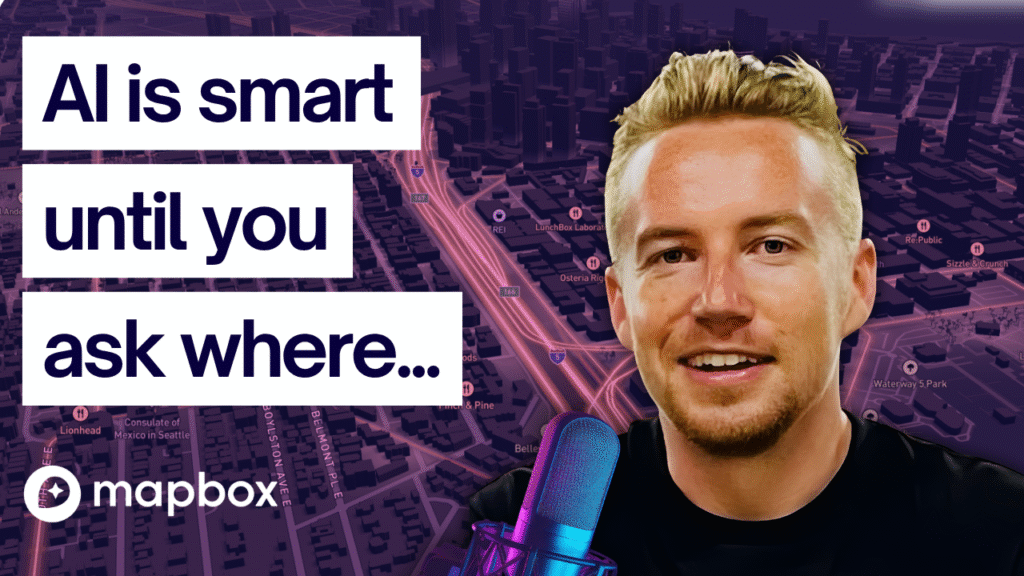
Most AI models today can answer facts, summarize documents, and write code. But ask them a simple question like “How do I get from here to the nearest coffee shop?” and they fail. They guess. They hallucinate. They break.
This gap between AI and the real world is one of the biggest opportunities in front of us. And companies like Mapbox are building straight into that gap.
In my conversation with Kieran McCann, who sits on the business team at Mapbox and works closely with leading AI labs like OpenAI, we explored how the next era of mapping is being defined right now. And it’s not just about prettier maps or faster tiles. It’s about AI native mapping, where maps become intelligent agents that understand place, movement, proximity, and context.
What follows is a breakdown of the most important ideas from our conversation and what they mean for GIS professionals, developers, and anyone watching the intersection of location and AI.
Why AI Still Can’t Answer “Where?”
Kieran put it plainly. Large language models don’t understand space. They don’t understand direction. They don’t understand where things are in relation to each other.
They can tell you you’ll “take I-95 north,” but they can’t reliably generate step-by-step navigation. They can’t point you to the nearest restaurant. They can’t ground their answers in real-world coordinates.
This is a huge limitation because “where” is one of the fundamental question types humans ask. And today’s AI falls short because:
- LLMs don’t contain a living map of the world.
- Their world knowledge is often months or years out of date.
- They were never designed for spatial reasoning or routing.
- Maps change constantly, which breaks static model knowledge.
As AI moves from chat interfaces to agents and physical-world applications, this missing “sense of place” becomes even more important.
This is where Mapbox is stepping in.
What AI Native Mapping Actually Means
AI native mapping is not just “adding AI” to a map. It means restructuring how maps work inside AI systems.
Kieran described two major directions Mapbox is pursuing:
1. Agents That Handle Spatial Tasks for LLMs
Imagine dragging a “map agent” into a workflow.
You ask a question. The LLM hands the “where” part of the question to the Mapbox agent. The agent:
- finds locations
- understands proximity
- runs routing
- highlights results visually
- returns the spatial insight in a form the model can use
The agent becomes a plug-and-play module for spatial intelligence.
2. Maps That Respond to You, Not the Other Way Around
Instead of clicking 20 times through a web map:
- you tell the map what you want
- the map pans, zooms, filters, and highlights automatically
- the interface becomes conversational, not manual
This shifts mapping from a tool you operate to a tool that participates in the interaction.
And it solves a big UX challenge. Most people are not expert map readers. An AI layer can guide users straight to the insight.
From “Map User” to “Map Builder”: How AI Changes Development
One of my favorite parts of this conversation was Kieran’s story of building small AI-powered prototypes with minimal coding experience. He used Replit, Mapbox APIs, and an AI coding assistant to build:
- a travel-time-to-airport calculator
- an AI map-style editor (which inspired a real Mapbox product feature)
He described the difference like going from ordering food in broken Spanish to becoming nearly fluent overnight. The AI tools didn’t replace his reasoning. They removed the friction.
This mirrors what many of us are experiencing.
AI reduces the cost of:
- starting
- prototyping
- iterating
- explaining an idea
- testing whether something is worth building
The biggest bottleneck in geospatial innovation has always been time to prototype. AI breaks that bottleneck.
Why Location Matters More as AI Goes Physical
Right now, most AI interaction happens in a chat box. But that’s temporary.
The next wave includes:
- personal agents on your phone
- AI copilots embedded in every app
- robots and drones navigating physical space
- wearables and AR devices
- real-world intelligence that depends on context
Every one of those scenarios requires location intelligence.
Kieran mentioned a term more people will hear soon: physical AI. Once AI moves into the physical environment, “where” becomes non-negotiable. Robots need to navigate. Devices need to orient themselves. Apps need to understand proximity and context.
And that’s why companies like Mapbox, who maintain living maps and real-time location data, will sit at the center of this shift.
AI Isn’t the Strategy. Your Strategy Needs AI.
One of the best insights from Kieran came from a recent conference he attended.
Most companies ask:
“What’s our AI strategy?”
Kieran says that’s the wrong question.
The real question is:
“What problems matter most, and how fundamental is AI to solving them?”
This reframing is important because the companies that succeed with AI:
- start with a real user problem
- then decide whether AI is the right tool
- avoid building AI for the sake of novelty
- evaluate whether AI meaningfully accelerates an existing process
The hype cycle is crowded. But the signal inside the noise is clear. AI will become embedded in every part of how we use maps, build software, analyze data, and interact with the world.
The Mapbox Model: Listen First, Build Fast
Instead of guessing what customers want, Mapbox did something simple but powerful. They watched the emerging problems inside AI labs and enterprise teams. Then they built directly into those needs.
That discovery loop mirrors the larger lesson Kieran emphasized:
- don’t wait
- experiment
- build prototypes
- test ideas fast
- treat iteration as a skill
AI lowers the cost of being wrong. And that means the people and companies who adapt fastest will win.
Practical Takeaways for GIS and Geospatial Professionals
Here are the most important actionable lessons from this conversation:
1. Your value is no longer just technical skills. It’s problem framing.
AI will write code, generate styles, and stitch workflows.
You bring the domain insight and decision-making.
2. Prototype everything.
You no longer need permission to explore an idea.
Build it. Show it. Share it.
3. Learn how agents work.
The future of GIS is not one monolithic model.
It’s a system of specialized agents passing tasks to each other.
4. Maps will become interactive assistants.
Expect dynamic, context-aware mapping to become standard.
5. Location intelligence becomes central as AI gets physical.
Devices, robots, vehicles, and real-world agents all rely on spatial awareness.
6. Start working with these tools now.
The field is rewriting itself every few months.
Early movers get the advantage.
Where to Learn More
Mapbox just released dozens of sessions from its virtual event, covering:
- building web maps
- AI powered location services
- new APIs and developer tools
- and early versions of their agent ecosystem
You can explore everything at Mapbox.com.
Final Thoughts
The next era of geospatial is not a better web map. It’s a smarter one. An adaptive one. A map that listens, reasons, and helps people reach answers faster.
AI native mapping is not a feature. It’s a shift in how we interact with place.
And based on this conversation with Kieran, the companies and professionals who embrace experimentation, rapid prototyping, and agent-based thinking will shape the next decade of geospatial.
